Almodovar | Mishra
(From January 11)

Re-watched with wife last night Almodovar's "Parallel Mothers", which bears a second watch, certainly. It's a wonderful piece of story-telling and a film that is both emotionally engaging, visually beautiful, and packed with meaning.
There's a sub-plot in the film about a dig to exhume victims of fascism, buried in a mass grave at the start of the Spanish civil war. D said, on watching the exhumation of skeletons at the end, that she could not help but be reminded of Gaza.
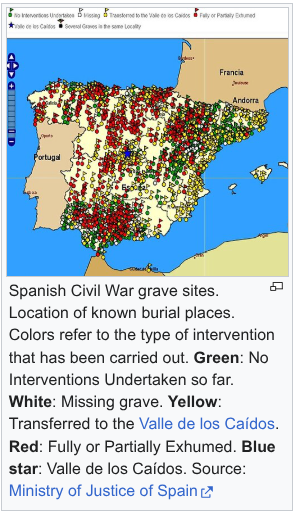
Map shown in Wikipedia of Spanish Civil War grave sites and those that have been exhumed so far
Wikipedia article on the White Terror in Spain
My day began and ended with stories of genocides, in Congo, Turkey and Spain; but my bedtime reading was in The World After Gaza, where I've reached a point that describes the ways in which the memory of the Shoah has been perpetuated in Israel. And I've just read a quotation that Mishra gives by Susan Sontag:
There is no such thing as collective memory. All memory is individual, unreproducible - it dies with each person. What is called collective memory is not a remembering but a stipulating that this is important, and this is the story about how it happened, with the pictures that lock the story in our minds.
So it's all about narratives and what we do with them. And it seems to me that even "individual" memory is subject to our past conditioning and present influences, such as thoughts about how other people will see a predicament, which is in turn affected by societal mores, portrayal in the media, proclamations by respected leaders, etc.
Unless we have the courage and unaffected capacilty to truly see or validly experience, how will we have the ability to remember?
“On ne voit bien qu’avec le coeur. L’essentiel est invisible pour les yeux.” Antoine de Saint-Exupéry
I think of Mary Seely Harris and her Kodak brownie again. And then I think of the faked video clips from Minneapolis.
Historical memory and its uses
Mishra (The World After Gaza) has a great deal to say about historical memory, and the way it is "used".
Early on in the book, he includes a quote by Yehuda Elkana, a Holocaust survivor and former director of the Van Leer Institute, who thought that the cruelty of Israel's Occupation of Palestinian territories stemmed from the feeling of victimhood engendered in Israelis from memorialisation of the Shoah and said 'It may be that it is important for the world at large to remember' the shoah… but Israelis 'must learn to forget'.
When I mentioned this idea to my wife she disagreed totally. as she recalled a program she once arranged here in the village on "memory and recognition". Instead of forgetting past traumas (like the Shoah, the Nakba, or the apartheid regime in South Africa), it was suggested there that memory could be a tool for conflict transformation; rather than forgetting, trying to forget, or, heaven forbid, suggesting to the victims than they forget. Through deep acknowledgement of the suffering caused, and honouring its memory, a healing could take place, as well as a deriving of the proper lessons to ensure that the same would not occur again.
An example given in the program was the TRC process that followed the regime change in South Africa, which though not perfect permitted a peaceful turnover of power rather than a bloodbath.
That's what I remember at least from the program. Mishra's description of Germany's holocaust remembrance culture is not described at all charitably by Mishra, even though it has done more than any other country to cultivate such remembrance.
Just as Israel seems to have derived from the Shoah the lesson to develop a strong army so that this would never again happen to Jews, he says that Germany has transitioned (officially at least) from anti-semitism to philo-semitism and unquestioning support for Israel; no matter what the country might actually do. This, however, fails to defeat other forms of racism and does not make the world safe from genocide.
He mentions the very small number of convictions of former Nazis in West Germany (many fewer than in East Germany), the fact that the country continued to be administered by the same people as during the 3rd Reich and Germany's lack of remembrance for other genocides for which Germany, as a colonial power, had been responsible in Africa.
It's Mishra's special position as an "outside observer", who grew up in post-colonial India, but one who is keenly interested in Middle Eastern culture and history, that makes this book so interesting.